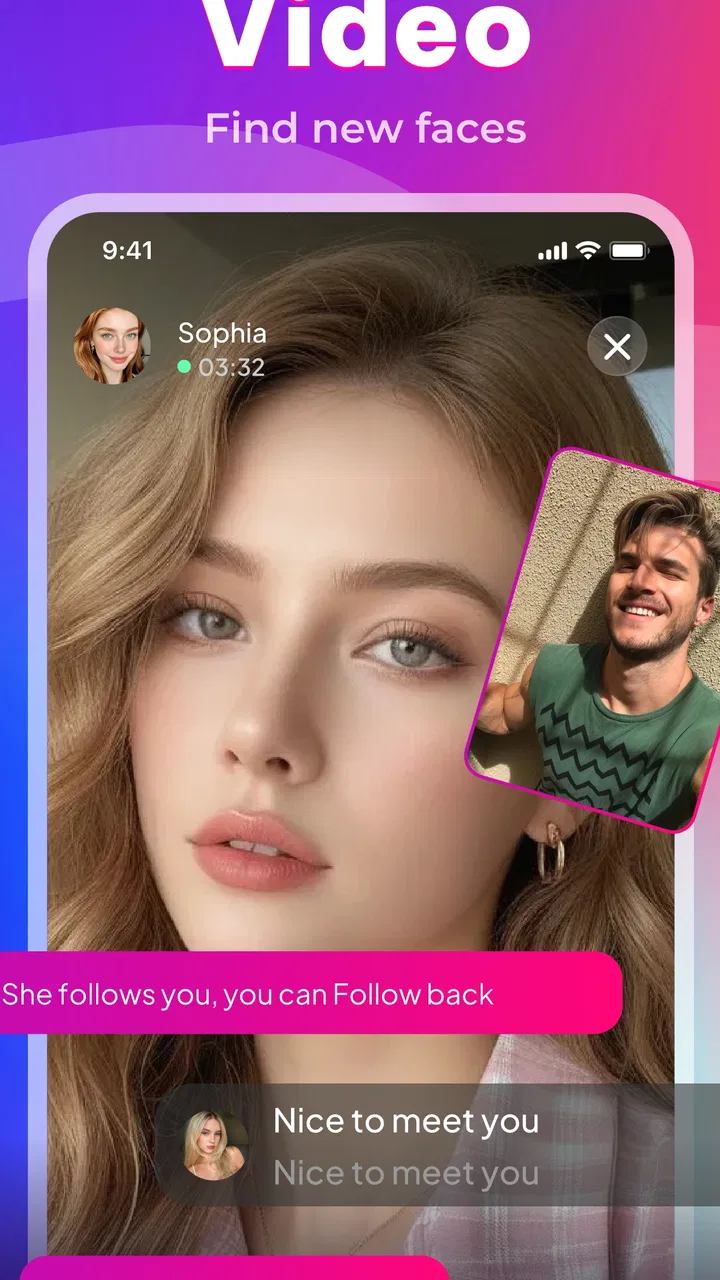
Niko - Video Chat, Share Fun
- 2.1
- Rating
- 1.00M
- Installs
- Free
- Price

 Analysis by App-foxy
I approached Niko - Video Chat, Share Fun as a lifestyle app built around meeting people and sharing moments through video chat. That focus sounds simple, but it changes what I expect from the app: I am not looking for a full social network, a polished photo archive, or a replacement for a private messenger. I am looking for a quick way to connect visually with other people and decide whether that interaction feels worthwhile.
My overall impression is mixed. The central idea is easy to understand, and video can make an interaction feel more immediate than text. At the same time, the experience needs patience because the app has a modest average rating of 2.1 from around 1.7 thousand ratings. That does not automatically make it unusable, but it is a clear signal to keep expectations realistic and test the experience carefully rather than assuming the large install count guarantees a smooth community.
What the video-chat idea changes in everyday use
The most important capability here is the emphasis on seeing and speaking with people instead of relying only on written messages. In practice, that can make a short exchange feel more personal. A face, a voice, and the timing of a response provide context that a profile or text bubble cannot always deliver.
You May Also Like

 Blood Strike: 2.5 Anniversary
Blood Strike’s Loadouts Turn Every Drop Into a Tactical Gamble
A close look at Blood Strike’s custom loadouts: how fast access to signature weapons reshapes its battle royale rhythm, rewards preparation, and narrows the gap between fights.

 Pandora - Music & Podcasts
Pandora’s Music Is Easy to Start, but Harder to Recover
Pandora’s strength is its low-effort path from a seed to a station. Its weak spot is how much confidence it asks you to place in connection, setup, and quiet recovery.

 8 Ball Pool
 Is Built on Rivalries, Rematches, and Routine
A close look at the rivalries, rematches, shared routines, and unanswered safety questions that turn a quick pool match into a persistent mobile community.

 Samsung Music
’s Quiet Strength Is Playing What You Already Own
Its reach comes less from spectacle than from dependable access to a personal library. That simplicity is both the app’s strongest retention engine and its ceiling.

 AccuWeather: Weather Radar
AccuWeather Review: A Quick, Clear Forecast for Everyday Decisions
For everyday plans, the best forecast is the one you can understand quickly. AccuWeather makes rain timing, radar, and local conditions easy to act on, with a few trade-offs.

 Hill Climb Racing
Why Hill Climb Racing Still Turns Crashes Into One More Run
A tiny car, a bumpy hill and one more upgrade: Hill Climb Racing keeps resurfacing because its simple chaos makes every near-miss feel personal.
More From Our News Desk



I find this approach most appealing when I want a lightweight social break rather than a long conversation. For example, after work I might have a few minutes before cooking dinner. Opening a video-focused app gives me a chance to interact without preparing a detailed post or maintaining a carefully edited profile. The trade-off is that video asks for more attention than silent browsing. I need to be somewhere reasonably comfortable, and I need to be ready for an interaction that feels more direct.
The app belongs to the lifestyle category, which fits its broad social purpose. It is not presented as a specialist tool for work meetings, language instruction, dating advice, or creator production. That matters because the best use is casual discovery and conversation. Anyone expecting the structured controls of a professional conference service or the deep matching systems of a dedicated dating platform may find the experience less focused.
The store summary, “Discover People, Share Moments,” captures the intended rhythm better than a long feature list would. I read it as an invitation to explore rather than a promise of a highly organized social routine. The short store description is simply “Niko,” so the app itself has to do the explaining once it is installed. I would not choose it because of the listing text alone; I would choose it if spontaneous video interaction is genuinely what I want.
How I would use it without making the experience awkward
My first practical tip is to treat the opening session as a test of fit, not as a commitment to the platform. I would check how quickly I understand the main screen, whether the path into video chat feels obvious, and whether I can leave an interaction without confusion. Those small details matter more in a social app than they do in a simple utility because uncertainty can make a conversation feel uncomfortable before it even begins.
I would also start when I have privacy and a stable setting. Video chat is less forgiving than text: background noise, poor lighting, or interruptions can make a short exchange feel worse than it deserves. This is not a technical claim about the app’s network performance; it is simply a sensible workflow for any service centered on live visual interaction. The best first impression comes when I can concentrate on the person rather than managing my surroundings.
A second useful habit is to keep the first conversation short. Instead of treating every new contact as someone I must continue speaking with, I would use the opening exchange to decide whether the tone is comfortable and whether the interaction feels natural. That makes the app easier to evaluate and reduces the pressure to stay in an uninteresting or unsuitable conversation.
Because the app is rated Mature 17+, I would regard age and personal boundaries as part of the decision to use it. I would not install it for a younger teenager, and I would not assume that an age label removes the need for caution. I would avoid revealing private details early, move away from conversations that become uncomfortable, and make sure the person using the device understands that video interaction can expose more than text does.
A realistic scenario where it makes sense
Imagine someone who has just moved to a new area and wants a low-effort way to meet people without immediately joining a club or arranging an in-person event. They have a free evening, a quiet room, and enough time for a few brief conversations. In that situation, Niko can serve as a first step: not a substitute for real-world friendships, but a way to discover whether talking with unfamiliar people feels enjoyable.
The same scenario also shows the app’s limits. A video conversation may create a quick sense of contact, but it does not automatically produce a lasting friendship. If I wanted detailed profiles, dependable search filters, organized groups, or a strong history of conversations, I would look toward a more established social platform designed around those specific needs. Niko is more suitable when the act of immediate interaction is the main point.
Another reasonable use is sharing a small moment with someone I have already met through the service. The video format can be more expressive than a message when I want to react to something in real time. Still, I would not treat it as a private archive for important memories unless the app clearly gives me the controls I need. A live social exchange and a secure personal storage system are different jobs, and I would keep those expectations separate.
Where the experience can become frustrating
The largest concern is not the concept itself but the gap between a promising concept and a consistently comfortable community experience. A low average rating suggests that many users have encountered problems serious enough to affect their opinion. Since ratings do not explain every individual complaint, I would not turn that number into a specific accusation. I would use it as a reason to proceed slowly and judge the current experience on my own device.
The install figure is also easy to misread. The app has passed one million installs, which shows that it has attracted broad attention, but reach is not the same as quality or activity in every location. A person in one region may find plenty of suitable interactions while another may see fewer appealing conversations. For a people-centered app, that local or time-based variation can matter more than the headline install count.
There is also a natural privacy trade-off in video chat. The more visible and immediate the interaction becomes, the more carefully I need to manage what appears on camera. A room, a workplace badge, a school item, or a notification can reveal information unintentionally. I would position the camera deliberately, avoid showing documents or addresses, and remember that a friendly conversation can still involve someone I do not know well.
I would be cautious about spending money before understanding the free experience. The app is free to install, while in-app purchases range from $0.99 to $99.99 per item. That is a wide span, so I would inspect each purchase screen carefully and avoid tapping through quickly. I would first decide whether the core social experience is useful without spending anything. If the app becomes enjoyable only after payment, I would compare that cost with a platform whose purpose and pricing are clearer to me.
That payment range is especially important for anyone sharing a device or account with family members. I would use the device’s purchase protections and make sure the person using the app understands that “free” refers to installation, not necessarily to every optional item inside the service. This is a practical safeguard, not a criticism unique to Niko, but it is worth taking seriously here because the available purchase levels differ substantially.
How it compares with familiar alternatives
Compared with ordinary messaging apps, Niko puts more emphasis on spontaneous visual contact. A messenger is usually better when I already know who I want to reach, need a written record, or want to answer at my own pace. Niko is more interesting when discovery and live interaction matter more than an established contact list.
Compared with social networks built around public posts, the video-chat approach can feel more direct and less dependent on creating polished content. On the other hand, a traditional social network usually gives me more ways to browse gradually, learn about someone through their posts, and decide whether I want to interact. If I dislike being placed into a live conversation before I have enough context, the usual feed-based alternative may suit me better.
Compared with dedicated video meeting tools, Niko is aimed at casual social use rather than meetings with a fixed agenda. A work-oriented service is the better choice for scheduled calls, screen sharing, team coordination, or formal communication. I would not use this lifestyle app for a job interview, a client appointment, or any conversation where reliability and professional controls are essential.
Compared with dating-focused services, Niko appears broader in purpose. That can be an advantage for people who want conversation without committing to a romantic framework. It can also be a disadvantage for someone who wants detailed compatibility tools, clear relationship intentions, or a carefully organized matching process. Choosing between them depends less on which interface looks nicer and more on whether I want open-ended social discovery or a defined kind of connection.
Small decisions that improve the first session
I would begin by setting a personal time limit for the first few sessions. This helps me distinguish genuine interest from endless scrolling or repeated attempts to find a satisfying interaction. If I am still unsure after several short visits, that uncertainty is useful information: the app may not be fitting the way I prefer to socialize.
I would also judge conversations by comfort and clarity rather than by how quickly they begin. A fast connection is not automatically a good one. I would look for respectful communication, an easy way to end the exchange, and a feeling that I can control my participation. If those basics are missing, no extra social feature would make the experience worthwhile for me.
A less obvious trade-off is the difference between novelty and continuity. Video discovery can be exciting because each interaction feels immediate, but that same novelty may make it harder to build a dependable routine. If my goal is a stable circle of friends, I would use the app only as an introduction and then move toward a communication method I trust for ongoing contact, with the other person’s agreement.
I would keep the app updated as well. The current version is 1.3.0, and the minimum requirement is Android 7.0 or later. That makes it accessible to many older Android devices, but compatibility alone does not tell me how comfortable the app will feel on every phone. A larger screen, a clear front camera, and enough battery may make a bigger practical difference than the operating-system requirement.
Who is most likely to benefit
I think Niko is most suitable for adults and older teens who specifically want casual video-based discovery and are comfortable setting boundaries with unfamiliar people. It may appeal to someone who finds text-only introductions flat and wants a more immediate sense of another person’s personality. It can also work for users who do not want to build a public feed before having a conversation.
It is less suitable for people who want a quiet, asynchronous social experience. If I prefer reading posts, replying later, or communicating only with people I already know, video chat adds pressure rather than value. I would also skip it for children, for anyone who needs a strongly moderated professional environment, and for users who are uncomfortable placing themselves on camera.
The developer is VIRTULINK TECHNOLOGY LIMITED, and the app is free to install. Its release date is December 24, 2025, so I would treat the product as something to evaluate in its present form rather than relying on assumptions from older social apps. The combination of a recent release, a broad install base, and a low average rating makes direct testing more important than reputation alone.
My recommendation is therefore conditional. Try it only if live, casual video interaction is the specific experience you want. Start without purchasing anything, protect your personal setting, keep early conversations brief, and pay attention to whether the available community feels respectful and worthwhile. If you want structured matching, dependable private messaging, professional calls, or an organized social archive, a more specialized alternative will probably serve you better.
For the right user, the app’s value is its immediacy: it can turn a vague wish to meet people into an actual conversation. For me, that is a worthwhile idea, but not enough to overlook the rating, the mature audience, the purchase range, or the ordinary risks of talking with strangers on camera. I would recommend Niko - Video Chat, Share Fun as a cautious experiment rather than an automatic everyday social hub.
FAQs for Niko - Video Chat, Share Fun
01What is Niko - Video Chat, Share Fun used for?
Niko - Video Chat, Share Fun is a social communication app focused on meeting people through video interactions, conversations, and shared entertainment. Users can typically create a profile, discover other members, start chats, and use video features to connect more personally. The exact experience can vary by region, account status, and available community activity, so reviewing the app’s current permissions and store description is recommended before signing up.
02Is Niko - Video Chat, Share Fun free to download and use?
The app may be free to download, but some communication tools, virtual items, premium features, or extended video-chat options can require in-app purchases or subscriptions. Before using paid functions, check the pricing displayed inside the application and confirm how credits or recurring payments work. Availability of free features and payment options may differ between Android and iOS, as well as by country.
03Is Niko - Video Chat, Share Fun safe for meeting strangers online?
As with any video-chat and social discovery platform, users should remain careful when communicating with people they do not know. Avoid sharing your home address, financial information, passwords, private documents, or other sensitive details. Use the app’s blocking and reporting tools when necessary, and leave conversations that become uncomfortable. Parents should also consider whether the service is appropriate for younger users and review its age requirements.
04What permissions does Niko - Video Chat, Share Fun require?
A video-chat application may request access to your camera and microphone so you can make video or voice calls. It might also request notifications, photos, storage, or other device permissions depending on the features you use. Grant only the permissions that are necessary, and review them in your phone’s settings. If you deny camera or microphone access, certain communication functions may not work correctly.
05Can I control who contacts me or delete my Niko account?
The available privacy controls may allow you to manage profile visibility, restrict messages, block users, or report inappropriate behavior. Look through the account, safety, and privacy sections after installation to understand these options. If you decide to stop using Niko, check the in-app settings or official support channels for account deletion instructions. Removing the app alone may not delete your profile or stored account data.
Pros
- Quick matching makes it easy to start conversations with new people.
- Video and text chat options suit different comfort levels.
- Simple interface is easy to navigate for first-time users.
- Fun sharing features can make conversations more engaging.
- Useful for meeting people beyond your local social circle.
Cons
- Interactions may vary greatly in quality depending on who you match with.
- Video chat can consume significant mobile data and battery power.
- Some features or interactions may require in-app purchases.
- Unexpected messages or calls can be uncomfortable for some users.
- Privacy settings should be reviewed carefully before sharing personal details.

Niko - Video Chat, Share Fun
Gallery